
Online school of orthodontic treatment planning "OrthoPlanner"
A step-by-step system for precise treatment planning in the permanent dentition with access to OrthoPlanner
For orthodontists
Learn to build ideal treatment plans even in complex cases
For students & residents
Start your orthodontic journey the right way and save years of trial and error

This course is designed so you never run into situations like these

"It seemed like a non-extraction case, but it resulted in significant protrusion…"
You’ll know the final incisor position before starting treatment

"I thought it could be treated without surgery, but after 3 years realized it wasn’t manageable…"
If the case can’t be compensated without orthognathic surgery, you’ll see it at the planning stage

"I thought the midline would be correct in the end, but the deviation remained..."
Asymmetric cases are very difficult without a clear algorithm. The midline will be on point

"There was a missing lower 5, I closed the space, and then the upper 7 was left without an antagonist..."
After the course, you’ll be able to predict this before approving the treatment plan

"I tried to compensate a class II case with extractions, but ended up moving the upper incisors out of the bone…"
You’ll understand incisor root movement limits at the planning stage

"I don’t understand how many mm a Herbst appliance can provide for class correction"
The course is fully structured around numbers and based on the latest scientific evidence
Why choose this course?

Proprietary method
Unique Andrey Tikhonov protocol based on 20 years of practice and research

Mentor support
The mentor helps implement the protocol and create treatment plans, plus interaction in a private colleague chat
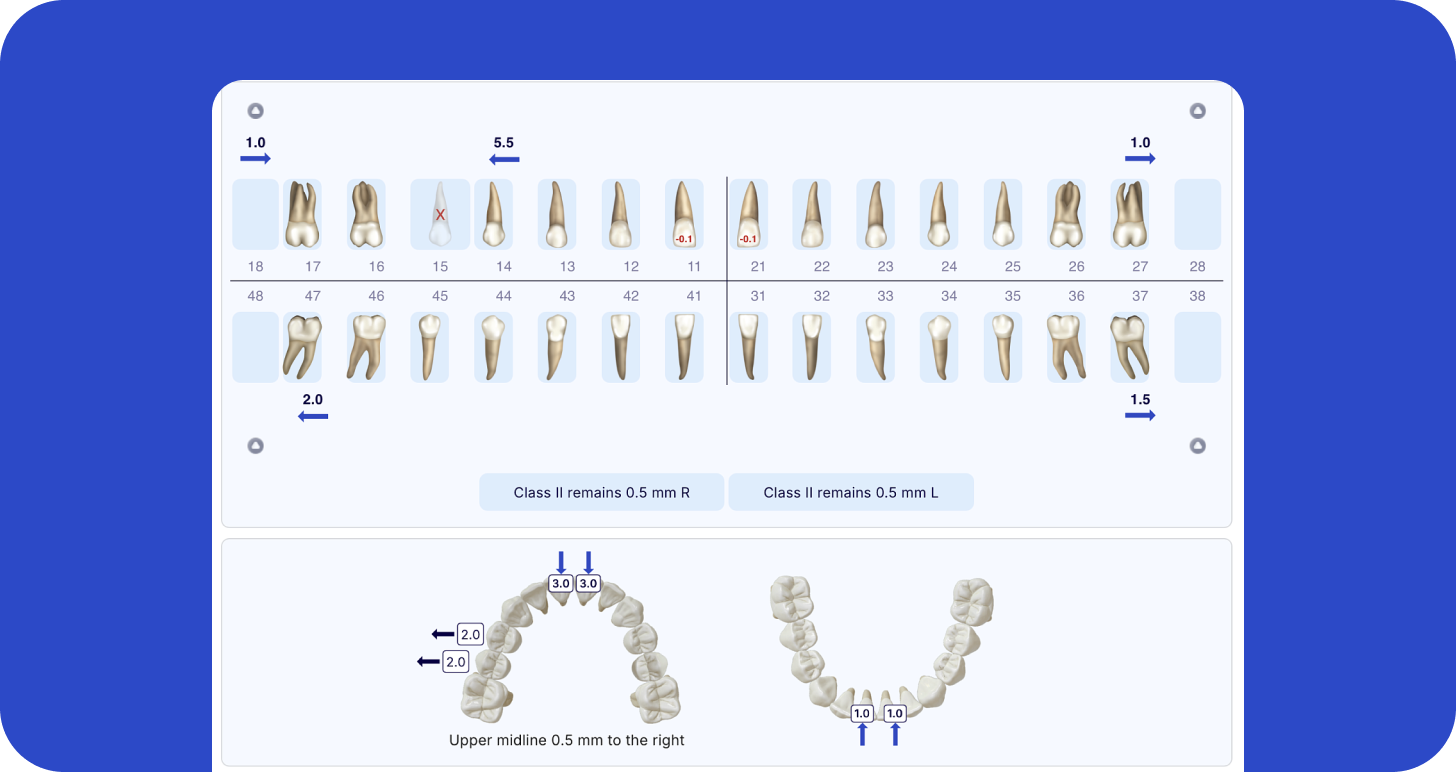
OrthoPlanner online service
Learn not just the theory, but also how to work in an innovative planning tool
Course program
Complaints, medical history, TMJ
Facial features, smile, display
“Other” section of diagnostic data
Tooth chart and initial geometry. Part 1
Initial geometry. Part 2
Initial geometry. Part 3
Structure and logic of the treatment plan builder
Protrusion and expansion for space management. Expansion module
Mandibular size and position adjustments. Growth, orthognathic surgery, autorotation
Calculation of upper posterior tooth movements
Calculation of lower posterior tooth movements
Calculation of movement and final inclination of the lower anterior teeth. Limits
Managing skeletal discrepancies. Orthognathic surgery. Compensation strategies and IPR
Assessing the feasibility of distal and mesial movement of posterior teeth. Extractions and implants
Treatment plan alerts — a planning support tool
Managing tooth size discrepancies and missing teeth
Treatment plan simplification and criteria for an adequate plan
Treatment plan discussion with the patient and consent-ready plan
Mechanics of treatment with braces and aligners
Key considerations and workflow aspects of using the planning service

Andrey Tikhonov
Course author, orthodontist since 2003, PhD, orthodontic speaker since 2006
After many years of practice, it became clear that even the most skilled clinicians are humans, and humans make mistakes. To minimize risks, a clear support algorithm is needed at every stage of treatment planning. That’s why I combined my experience and the results of dozens of studies into this training course and the OrthoPlanner service
Pricing
- 20 online lessons of ~30 minutes each
- 1 year – for completing the course
- 3 months – mentor support
- 3 months – access to OrthoPlanner and then 10 cases free
- unlimited – private colleague chat
990 $
What colleagues say: reviews of the
treatment planning course
Alfiya Farkhutdinova
Clinic «Master of Smiles»
28.04.2026
Andrey and Sergey Tikhonov’s online school for orthodontic treatment planning is a highly comprehensive and content-rich training program. Combined with the OrthoPlanner software, it leaves virtually no room for error when planning treatment for complex cases.
The step-by-step algorithm for creating a treatment plan from start to finish has become clear. Within the service itself, each sequential step includes prompts and warnings that are worth many years of practical experience, covering even subtle aspects of treatment mechanics, as well as checklists for doctors and treatment plans for patient signature.
I give my most sincere recommendation to both beginners and experienced colleagues.
read full text

Tatyana Obukhova
Moscow, MosDentalClub Clinic
27.03.2026
I consider myself a fairly experienced doctor. In my case, as with many adult practitioners, “experience is the son of hard mistakes,” due to knowledge gaps left by the educational system. I was always driven by the desire to understand and develop a universal treatment algorithm for different types of cases. The Planning School gave me that opportunity.
It is a treasure trove of information essential for an orthodontist—scientifically grounded and enriched by the creators’ experience. And I truly envy young doctors who have the opportunity to simply complete this Planning School and gain deep knowledge and confidence in their actions, shortening their path to high-quality, predictable work.
My deepest gratitude to Andrey Viktorovich for this. I strongly recommend it to all colleagues.
read full text

Darya Gospodarik
Minsk, Cosmedent Clinic
25.03.2026
I have watched all the videos from the Planning School, and here’s what I can say: I definitely recommend taking it! It is useful both for beginner doctors and for those with several years of experience, because unfortunately there are issues with how orthodontics is taught at some universities, and after graduating from departments, we often have enough knowledge gaps that later need to be filled independently.
After working for some time, you begin to see that some cases could have been finished better, and the reason is that diagnostic data were assessed incorrectly or something was overlooked before creating the treatment plan, because there was no clear and detailed algorithm for collecting and interpreting diagnostic data.
One can only envy beginner colleagues who complete this training—they will be able to start working correctly right away, with an understanding of what to look at, how to measure, how to make decisions, and how to make outcomes more predictable. And the planning service, which they will get access to after the training, will become a virtual assistant as well—like the voice of an experienced colleague we often lack, especially at the beginning of the orthodontic journey.
I recommend studying it thoughtfully. As for me, despite my many years of love for measuring models and scans, after completing the training I still feel how much the quality of the treatment plans I now offer my patients has improved.
read full text
Natalya Trubochkina
City Dental Clinic No. 33, Saint Petersburg
23.03.2026
Thank you very much for creating the OrthoPlaanner service and for the opportunity to learn how to use it! I liked that while gradually mastering the lessons in the online school, every diagnostic point and the importance of its evaluation are explained in detail, with clear examples from clinical cases.
A detailed explanation is provided of the action algorithm that leads to understanding what moves where in the dental arches, why it moves, and what the final result will be.
I have already started applying the knowledge gained from the online school in my practice. Thank you very much for sharing information, helping us grow, and improve the quality of our work!
read full text
Questions and answers
Who is this course designed for?
This course is designed for orthodontists at all stages of their professional careers. It is equally valuable for young specialists who want to build a solid foundation in treatment planning from the very beginning, as well as for experienced orthodontists looking to systematize their knowledge, improve treatment predictability, and confidently manage complex clinical cases.
What will I be able to do after completing the course?
By the end of the course, you will master a structured approach to orthodontic treatment planning and learn to make clinical decisions based on objective analysis rather than intuition or personal experience alone.
You will learn how to:
analyze clinical cases using a consistent treatment planning algorithm;
select the most appropriate treatment strategy;
anticipate potential challenges before treatment begins;
confidently explain and justify your treatment plan to patients;
manage even complex clinical cases with greater confidence.
You will be able to apply your new knowledge in daily clinical practice from the very beginning of the course.
What will I be able to do after completing the course?
By the end of the course, you will master a structured approach to orthodontic treatment planning and learn to make clinical decisions based on objective analysis rather than intuition or personal experience alone.
You will learn how to:
analyze clinical cases using a consistent treatment planning algorithm;
select the most appropriate treatment strategy;
anticipate potential challenges before treatment begins;
confidently explain and justify your treatment plan to patients;
manage even complex clinical cases with greater confidence.
You will be able to apply your new knowledge in daily clinical practice from the very beginning of the course.
Is the course still valuable if I don't plan to use OrthoPlanner?
Absolutely.
The core value of this course lies in the treatment planning methodology—not in the software itself.
More than 80% of the course focuses on clinical reasoning, diagnosis, and decision-making principles that can be applied regardless of whether you use any digital planning tools.
Access to OrthoPlanner is an additional benefit. It allows you to practice your skills on real clinical cases, reinforce the treatment planning workflow, and gain confidence much faster. After completing the course, you can decide whether you wish to continue using the platform in your practice.
Is this course suitable if I am still in my orthodontic residency?
Yes.
The course is specifically designed to help young orthodontists develop strong clinical thinking early in their careers and avoid many of the mistakes that often take years of experience to overcome.
If you are already treating patients independently, you will be able to implement the course methodology immediately.
Will this course be useful for experienced orthodontists?
Absolutely.
Experienced orthodontists often report that the course helps them organize and systematize their existing knowledge, improve consistency in treatment planning, and achieve more predictable clinical outcomes.
Even if you already have your own diagnostic approach, the methodology presented in this course offers a more structured framework for making clinical decisions.
How is the course delivered?
The course is delivered entirely online.
After completing your purchase, you will receive access to your personal learning platform containing video lectures, supporting materials, and practical assignments. You can study whenever it is most convenient for you while applying your new knowledge directly in clinical practice.
Throughout the course, you will also have access to OrthoPlanner to practice treatment planning using real clinical cases.
Do I have to complete the course in order, or can I study individual topics?
We strongly recommend completing the course in the intended sequence, as each lesson builds upon the previous one. This approach helps develop systematic clinical thinking and ensures the most effective understanding of the treatment planning process.
At the same time, you are free to study at your own pace. Course access remains available for one year after enrollment, giving you plenty of time to complete the program while balancing your clinical workload and revisit previous lessons whenever needed.
How much time should I plan to dedicate to the course?
You are free to study at your own pace.
Most participants spend approximately 2–4 hours per week on the course, although you may complete it faster or spread your learning over a longer period.
Since access is available for one full year, you can comfortably combine your studies with your everyday clinical practice.
Will I be able to ask questions during the course?
Yes.
The course includes mentor support throughout your learning journey.
You will be able to ask questions about the course content, receive clarification on challenging topics, and get guidance on practical assignments, making it much easier to integrate the new methodology into your daily practice.
Are there any assignments?
Yes.
Most lessons include short quizzes that typically take between one and ten minutes to complete. These exercises help reinforce the material and ensure that key concepts have been understood correctly.
At the end of the course, you will complete a final treatment planning assignment based on a clinical case. Successful completion unlocks a bonus lesson and qualifies you to independently use OrthoPlanner.
If you do not successfully complete the final assignment on your first attempt, your mentor will review your work, explain any mistakes, and give you another opportunity to submit it.
What is included in the course fee?
Your enrollment includes:
full access to all course lessons;
supplementary educational materials;
quizzes and the final assessment;
access to OrthoPlanner for the period specified in your selected package;
mentor guidance and support throughout the course.
The exact features included in each package are listed on the course webpage.
Can I get a refund if the course isn't right for me?
Yes.
We understand that investing in professional education requires trust.
That's why you can begin the course with complete confidence. If, within the first month after enrollment (or before completing the first seven lessons, whichever comes first), you decide that the course does not meet your expectations, simply let us know.
We will provide a full refund with no unnecessary questions. The only thing we ask is that you briefly explain what did not meet your expectations so that we can continue improving the course.
More than 100 orthodontists have already enrolled in the program. The overwhelming majority successfully complete the course, leave highly positive feedback, and begin applying the treatment planning methodology in their daily clinical practice. That is why we are confident in the quality of our program and are happy to offer you a risk-free opportunity to get started.
What happens after I enroll?
Immediately after your payment is confirmed, you will receive instructions for accessing your personal learning account and can begin studying right away.
If you experience any technical issues with access or the learning platform, our support team will assist you promptly so that you can focus entirely on your education.